
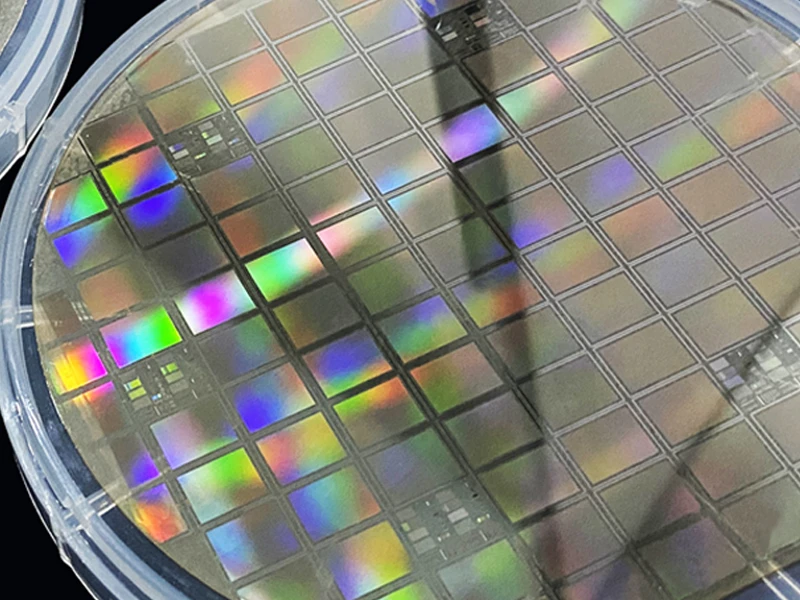



Wafer flat and wafer notch are critical features for determining wafer orientation in the wafer manufacturing process, playing a vital role in wafer processing, alignment, and inspection.
1. Wafer Flat
A wafer flat refers to a straight, flattened section on the outer edge of a wafer. It is used to mark the specific orientation of the wafer, ensuring precise alignment during wafer processing and handling. Think of it as the needle of a compass, guiding the correct placement of the wafer in manufacturing equipment.

Functions and Roles
- Orientation Indication: The flat typically marks the specific crystallographic plane of the wafer. For example, in a P-type <100> silicon wafer, the flat helps identify its primary crystallographic direction. This is because silicon crystals with different orientations exhibit distinct physical and electrical properties, and the wafer flat ensures accurate recognition of the crystal direction during wafer grinding and processing.
- Alignment Marker: Multiple alignment steps are required in wafer manufacturing, such as lithography alignment and etching alignment. The flat acts like a coordinate marker on a map, assisting equipment in aligning the wafer to guarantee processing precision.
- Analogy: The wafer flat can be compared to a guide line on a puzzle, indicating how to correctly assemble components. Without such guide lines, proper assembly would be nearly impossible.
2. Wafer Notch
A wafer notch is a small cutout or indentation on the outer edge of a wafer. Similar to the flat, it marks wafer orientation but differs in shape and application—while the flat is a straight section, the notch is a physical indentation.

Functions and Roles
- Precise Positioning: The notch provides more accurate orientation marking, especially for larger wafers (e.g., 300mm wafers). It allows manufacturing equipment to easily identify wafer orientation, preventing alignment errors caused by wafer rotation or slight movement during wafer polishing and other processes.
- Alignment Error Prevention: As a reference point, the notch helps automated equipment maintain consistent wafer orientation throughout processing. It reduces human error and improves production efficiency.
- Analogy: The notch can be likened to the valve stem of a car tire—it does not affect rotation but serves as a key positioning point to ensure accurate tire installation.
3. The Relationship Between Wafer Flat and Wafer Notch
Wafer flat and notch complement each other in wafer manufacturing. The flat provides a general orientation reference, while the notch offers a physical marker for further precise positioning. They often coexist in most applications, particularly for large-size wafers (e.g., 300mm wafers).

Collaborative Roles in Wafer Processing
- The wafer flat determines the general orientation of the wafer, enabling initial alignment;
- The notch further provides a physical feature for equipment to identify orientation with higher precision, ensuring accuracy throughout the manufacturing process.
4. Key Considerations in Practical Applications
- Impact on Production: The precision of the flat and notch is critical to overall wafer processing accuracy. Errors in their positioning can lead to unstable electrical properties of the wafer, affecting final chip performance. Thus, ensuring the accuracy of these features during production is essential.
- Differences in Marking Methods: Different wafer suppliers may adopt varying marking approaches—some wafers have only a flat, while others have both a flat and a notch. The design of these markers must consider equipment compatibility and production process requirements, especially for processes like wafer dicing and packaging.
5. Summary
While differing in appearance, wafer flat and notch collectively mark wafer orientation and ensure alignment precision. The flat acts like a compass, guiding general direction, while the notch serves as a more precise physical feature, maintaining orientation consistency during manufacturing. Both are indispensable in modern wafer production, and their role becomes even more critical in the manufacturing of large-size wafers.