
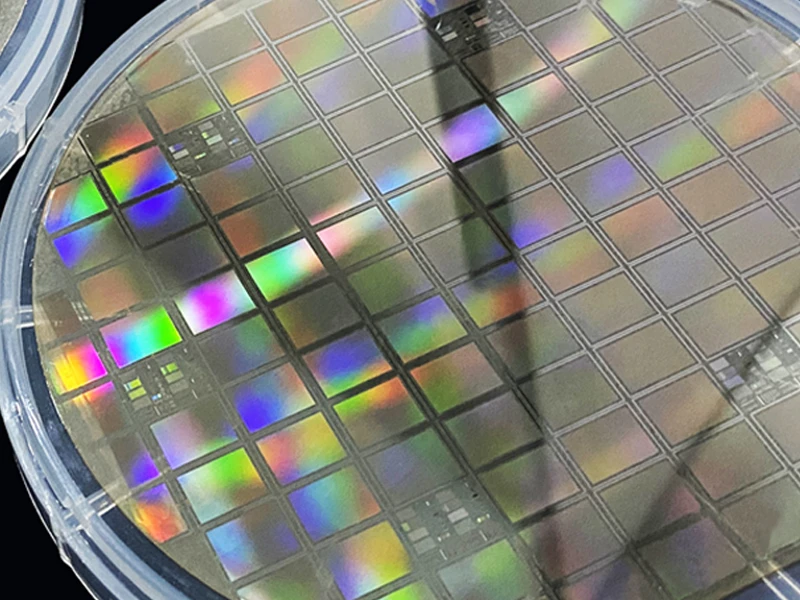



As a crucial III-V compound semiconductor material, Indium Phosphide (InP) has become a core substrate for fiber optic communications, aerospace, and ultra-high-frequency devices due to its superior radiation resistance, high electron mobility, and excellent optical properties. However, because InP is soft and brittle, it is highly susceptible to Surface Damage (SD) and invisible Subsurface Damage (SSD) during manufacturing. To obtain an atomic-level ultra-smooth, damage-free surface required for epitaxial growth, precise slicing, grinding, and polishing processes are mandatory. Below is an in-depth analysis and future outlook for these three core processing technologies.
1. Wafer Slicing: Balancing Brittle Removal and Damage Control
Slicing is the initial step in wafer processing, directly determining the allowance and difficulty of subsequent steps. Currently, diamond wire sawing is the dominant method.
Material Removal Mechanism: During slicing, the InP material is primarily removed via a brittle fracture mechanism. While this ensures high processing efficiency, it inevitably induces micro-cracks and deep subsurface damage (SSD).
Parameter Optimization: Studies show that increasing the wire speed or decreasing the feed rate can effectively reduce the SSD depth and improve surface quality.Anisotropy and Doping Effects: Different regions of the wafer exhibit machining anisotropy, which can lead to “saddle-shaped” distortions. Additionally, the doping type significantly affects the material’s corrosion rate, ordered as: S-doped > Fe-doped > Undoped > Zn-doped. Optimizing machining stress and corrosion schemes is critical to minimizing wafer warpage.

2. Wafer Grinding: Synergistic Innovation of Free and Fixed Abrasives
Grinding aims to remove the damage layer left by slicing and improve thickness variation, warpage, and surface roughness.
Crystallographic Differences: Molecular dynamics simulations reveal that different crystal planes exhibit distinct removal mechanisms. The (100) plane demonstrates excellent atomic plastic flow, yielding the highest Material Removal Rate (MRR) and the lowest surface roughness. In contrast, the (110) and (111) planes show a coexistence of brittle and plastic behavior, leading to surface chipping.Process Innovation: Traditional free abrasives suffer from low efficiency, while standalone fixed abrasives easily cause surface damage. The current frontier is free abrasive-assisted fixed abrasive grinding. The free abrasives not only enhance the self-dressing ability of the grinding pad but also improve the self-sharpening of the abrasives, effectively enhancing surface quality while maintaining extreme processing efficiency.

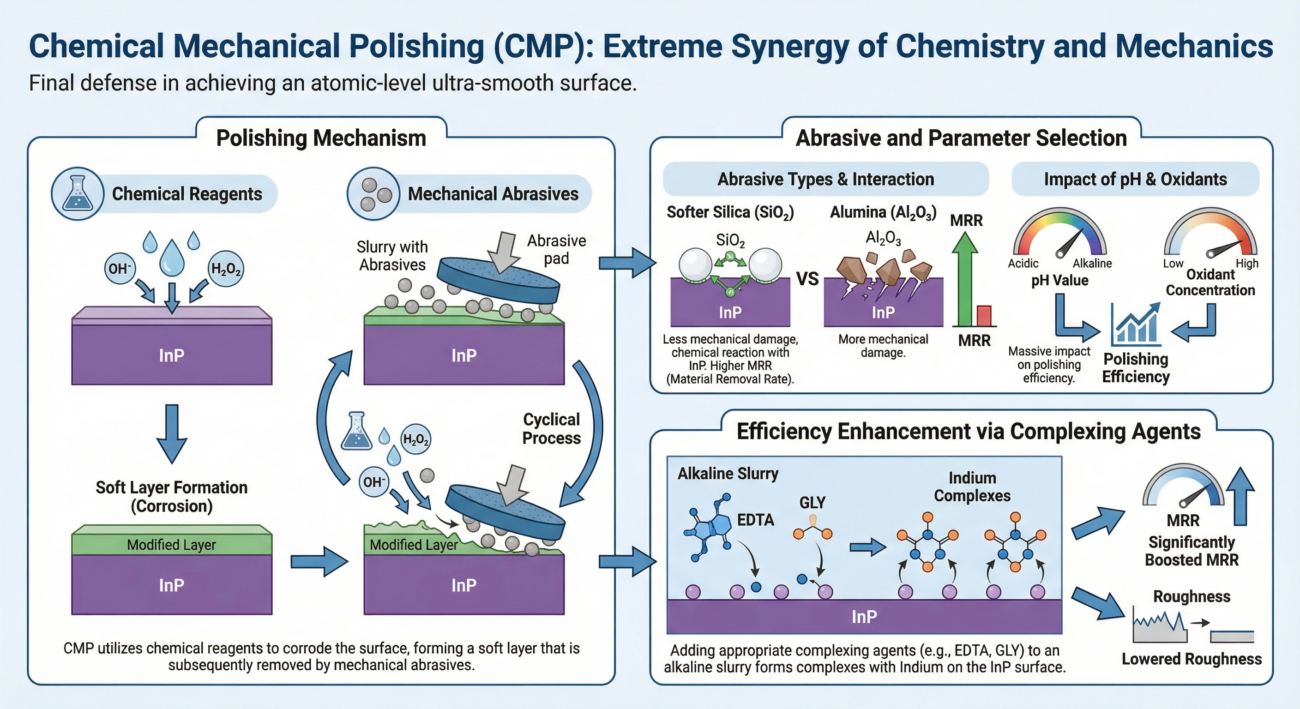
3. Chemical Mechanical Polishing (CMP): Extreme Synergy of Chemistry and Mechanics
Polishing is the final defense in achieving an atomic-level ultra-smooth surface.
Polishing Mechanism: CMP utilizes chemical reagents to corrode the surface, forming a soft layer that is subsequently removed by mechanical abrasives in a cyclical process.
Abrasive and Parameter Selection: Softer Silica (SiO2) abrasives cause less mechanical damage than alumina abrasives and chemically react with InP, resulting in a higher MRR. Furthermore, the pH value and oxidant concentration have a massive impact on polishing efficiency.
Efficiency Enhancement via Complexing Agents: Adding appropriate complexing agents to an alkaline slurry can drastically improve processing efficiency. For instance, the addition of EDTA and GLY forms complexes with the Indium on the InP surface, significantly boosting the MRR and lowering roughness.
4. Conclusion and Future Outlook
To achieve high-quality, highly efficient, damage-free, and eco-friendly processing of InP wafers, future research will focus on the following dimensions:
Deepening Mechanistic Understanding: Combining theoretical calculations, simulations, and empirical verification to explore the evolution of SSD during elastic-plastic transitions, dislocation propagation, and phase transformations in InP.
Green Manufacturing: Developing efficient multi-wire sawing technologies using deionized water as a lubricant, as well as green CMP slurries that eliminate harsh acids and bases to reduce hazardous waste pollution at the source.
Intelligent Multi-Parameter Optimization: Introducing orthogonal experiments, random forests, or multi-objective particle swarm optimization algorithms to precisely control the chemical-mechanical synergy, fully integrating the “mechanical properties-slicing-grinding-polishing” atomic-level manufacturing system.
